Richard Bartle is widely credited (along with Roy Trubshaw) with the creation of the worlds first virtual world, and his insights into current MMORPG developments are widely respected and derided in equal measure it would seem.
In this talk which was given at GDC Online 2010 last month, Prof. Bartle relates the thought processes that he thinks have been neglected in the development of todays MMORPGs and how he and Trubshaw made MUD.
A very enlightening talk about how MMO developers can recapture the immersion and expression which he found that he had created in MUD.
M out
Showing posts with label conferences.. Show all posts
Showing posts with label conferences.. Show all posts


27 Sept 2010
IGI 2010 - Part III
Part I and Part II can be found by clicking the relevant links.
After our wonderful lunch (did I mention that it included whale meat? Yummy!) The next session was announced and we returned to our seats. The first session of the afternoon was entitled Game Design for the Future and kicked off with Torfi Frans Ólafsson, a Senior producer from CCP. His talk was called Virtual Reality beyond goggles and gloves.
Reaching abck into the mid nineties he reminded us what used to be meant by virtual reality:

It wasn't pretty or graceful and the graphics were a bit rubbish. The ideas were there but the technology was not up to realising them. Torfi also cited books such as Neuromancer and Snow Crash
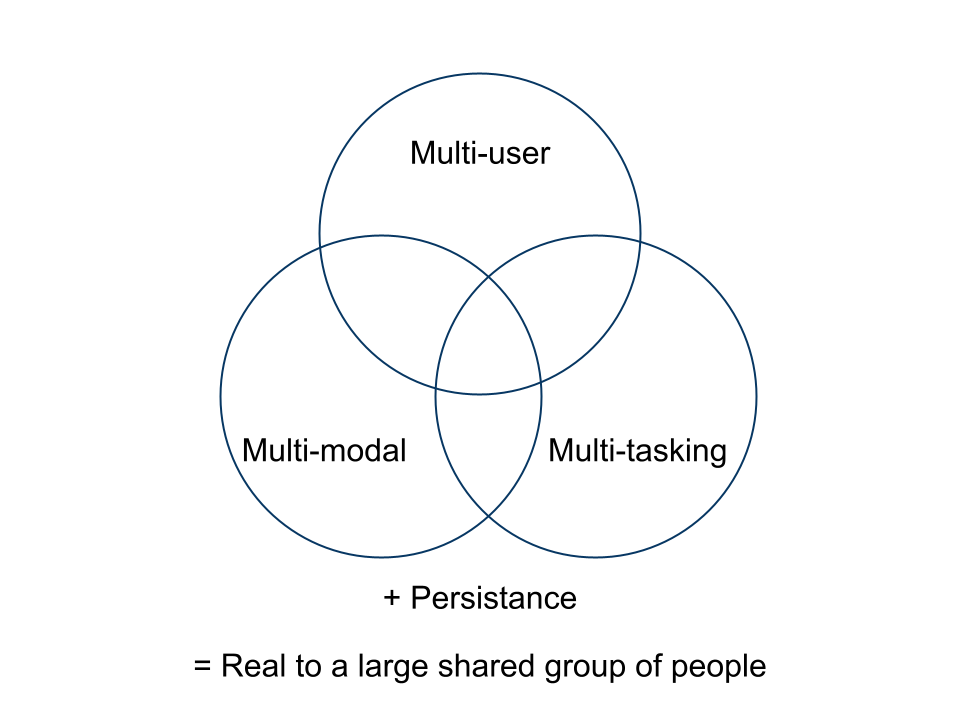
 as giving a view of Virtual reality which was completely singular. Virtual reality has changed, it is no longer about wearing a bulky headset and walking around bumping into things. Virtual reality is now more about a shared online experience, using multiple means of access and doing many things at the same time.
It was imagined in these books, and by the creators of VR hardware that exploring a virtual world would be an experience that you would participate in whilst doing nothing else.The early VR visionaries had no conception of how modern computer users make use of their time online. For example, whilst writing this blog post, I have 11 other tabs open in my browser, and MSN messenger running in the background. If I were on my usual machine I'd probably be listening to the radio or watching a movie as well (2 monitors don't you know). Torfi's point was that experiencing a virtual environment is not a singular experience. We don't shop online by walking down a virtual 3d street looking in each virtual window as we pass, we open all of the websites we want to shop at simultaneously and compare the prices next to each other, whilst tweeting about it and filling in our Facebook status and chatting with our friends on MSN and watching a movie or the latest episode of Desperate Housewives (oh no, my dirty secret is out o.O). We are multitasking beings when we're online, I ofetn play EVE with 2 clients at once as do many others. Our virtual experiences are not what our forefathers imagined them to be.
Another difference between the idea of VR from decades ago and now is that the means by which such worlds are accessed are no longer singular either. In WoW you can play the auction house from your phone or a website without having to log into the main client. Guild Wars 2 is also building on multi-modal functionality with iPhone apps that let you track what your friends are doing in game when you are away from your computer. EVE has been multi-modal for a while through third party applications such as Aura and Capsuleer, and the launch of EVE Gate is only serving to extend that multi-modality more. CCP is also exploring other ways of actually affecting what happens in the game world directly with Dust 514, a console shooter set in the same universe as EVE and affecting the planets of that immense universe in an entirely different way. We can access Facebook and Twitter from our phones, having conversations with people who are using totally different equipment to access their accounts.
Virtual reality has become a shared experience rather than a representation of a physical place. Rather than reality being defined by the pixels you look at it has become something that you experience, whatever form that experience takes. Whatever reality is is pretty much all in our heads anyway, even in everyday life. Torfi summed up his thinking with the following diagram:
The next talk was from Jonathan Osborne from Gogogic, and covered some of the history of gaming from tennis for two all the way up to games like Mass Effect, Halo: Reach, and of course Vikings of Thule. His main point was that at the forefront of gaming, there are no guidebooks or maps fro where its going to lead next. Social and casual gaming will gain depth as more people become participation literate and games move down the Maslow Pyramid. Location based gaming may be the next big thing but there's no real way of knowing. One thing he was certain about is that games will interact more and more with reality as the technology to play them on becomes more and more ubiquitous.
One thing he higlighted, using the examples of the original Quake and Halo was the level of technical knowhow required to become a gamer has decreased considerably. When Quake was released it was only the technically savvy that could run it. Those with the best machines and the know-how required to get the most out of them played Quake, those without had a PS1. Now everyone with an Xbox or PS3 can play Quake-like games which are even more power hungry but less knowledge dependent. You don't need to know how to adjust your autoexec.bat so that the game runs, you just shove the disc in and away it goes. This lowering of the technical barriers to gaming has widened the market and consequently widened the tastes that the games industry has to cater to, leading to a highly diverse market where there is a niche for just about everything.
He also hinted at a new project from Gogogic which will be landing sometime next year and is currently named Rupture. No other details but I'll be keeping my eyes peeled.
The final talk of this session was from Deepa Lyengar of Mindgames, and was about making real brain training games which used the latest technology to teach people how to relax and/or concentrate. Starting with the perpetual problem of how to make educational games without them being overtly educational and divorcing them completely from the dreaded 'edutainment' moniker. Her argument is that games are already teaching us things, its just that the things they're teaching are not directly applicable outside of the game. Indeed, many are simply improving our hand-eye co-ordination and increasing our skill at that particular game. Mindgames' goal is to develop games which teach us how to do something that will have wider applications than simply being better at the game. They want to make games that teach us how to meditate.
Using the latest brainwave interfaces and an iPhone, Tug of Mind aims to teach people how to relax by letting them turn a photo of someone into an angry face and then, utilising the NeuroSky MindSet, change their brainwaves to make the face happy. Using the same positive feedback systems that many games use to teach you how to blow stuff up more accurately, Tug of Mind teaches you the skills necessary to relax in stressful situations. Describing their products as 'Games with benefits', Mingames are trying to avoid being lumped in with edutainment and serious games which are often made with education and training as the priority rather than being actually fun to play.
Deepa admitted that there are challenges to designing games for the new brainwave interfaces in that when you have a physical button you know almost instinctively what you have to do and it all boils down to how and when you hit the button. With their games the challenge is that there is no button (insert 'there is no spoon' reference here) and its quite hard to bridge the gap between the player's introspective experience and the external stimulus. But surely thats the point of the game, to teach the player to know their own mind and learn where their internal button is so they can press it whenever they want.
After a quick break for more coffee it was time for the final session, which was by far the driest and least upbeat of the day, dealing as it did with the current economic situation in Iceland and whether the country has what it takes to sustain such a vibrant and innovative gaming industry, the speakers were generally in agreement with regards to what was needed for Iceland to become a world leader in the gaming sector; political and economic stability. greater support for R&D, ease of immigration so that talent is not put off by the hassle of coming to live here, a top class educational system (which it by and large already has) and a less punitive tax regime. Two things that all the speakers agreed on in the Q&A afterwards was that for the Icelandic gaming industry to survive there cannot be another crash similar to the one that occurred at the end of 2008 and the restrictions on capital investment from abroad should be lessened somewhat if not lifted altogether.
And so on that fairly downbeat note, but with a hopeful closing address from Sigurlina Ingvarsdóttir of CCP we retired to the blue lagoon for a soak in the milky, mineral enriched, warm water. A relaxing end to a very stimulating and informative day, complete with blue cocktails.
All in all there are many reasons to be optimistic about gaming's future in Iceland. There are companies here which are poised to take advantage of the new technological landscape being laid before them and as one of the most connected countries in the world there are few places better placed to experimant and play with what that connectivity means. Iceland has seen some hard times in recent years, and is still seeing them now, but if they can weather this storm and come out the other side stronger and more determined to lead the field going into the 21st century, Iceland's games industry has an awful lot going for it.
My thanks are extended to CCP for providing me with the opportunity to attend and the IGI for putting on a great day for all concerned.
M out
More information about the IGI and further details about the organisation, speakers and their presentations can be found at http://icelandicgamingindustry.ning.com/
After our wonderful lunch (did I mention that it included whale meat? Yummy!) The next session was announced and we returned to our seats. The first session of the afternoon was entitled Game Design for the Future and kicked off with Torfi Frans Ólafsson, a Senior producer from CCP. His talk was called Virtual Reality beyond goggles and gloves.
Reaching abck into the mid nineties he reminded us what used to be meant by virtual reality:
It wasn't pretty or graceful and the graphics were a bit rubbish. The ideas were there but the technology was not up to realising them. Torfi also cited books such as Neuromancer
and Snow Crash as giving a view of Virtual reality which was completely singular. Virtual reality has changed, it is no longer about wearing a bulky headset and walking around bumping into things. Virtual reality is now more about a shared online experience, using multiple means of access and doing many things at the same time.It was imagined in these books, and by the creators of VR hardware that exploring a virtual world would be an experience that you would participate in whilst doing nothing else.The early VR visionaries had no conception of how modern computer users make use of their time online. For example, whilst writing this blog post, I have 11 other tabs open in my browser, and MSN messenger running in the background. If I were on my usual machine I'd probably be listening to the radio or watching a movie as well (2 monitors don't you know). Torfi's point was that experiencing a virtual environment is not a singular experience. We don't shop online by walking down a virtual 3d street looking in each virtual window as we pass, we open all of the websites we want to shop at simultaneously and compare the prices next to each other, whilst tweeting about it and filling in our Facebook status and chatting with our friends on MSN and watching a movie or the latest episode of Desperate Housewives (oh no, my dirty secret is out o.O). We are multitasking beings when we're online, I ofetn play EVE with 2 clients at once as do many others. Our virtual experiences are not what our forefathers imagined them to be.
Another difference between the idea of VR from decades ago and now is that the means by which such worlds are accessed are no longer singular either. In WoW you can play the auction house from your phone or a website without having to log into the main client. Guild Wars 2 is also building on multi-modal functionality with iPhone apps that let you track what your friends are doing in game when you are away from your computer. EVE has been multi-modal for a while through third party applications such as Aura and Capsuleer, and the launch of EVE Gate is only serving to extend that multi-modality more. CCP is also exploring other ways of actually affecting what happens in the game world directly with Dust 514, a console shooter set in the same universe as EVE and affecting the planets of that immense universe in an entirely different way. We can access Facebook and Twitter from our phones, having conversations with people who are using totally different equipment to access their accounts.
Virtual reality has become a shared experience rather than a representation of a physical place. Rather than reality being defined by the pixels you look at it has become something that you experience, whatever form that experience takes. Whatever reality is is pretty much all in our heads anyway, even in everyday life. Torfi summed up his thinking with the following diagram:
The next talk was from Jonathan Osborne from Gogogic, and covered some of the history of gaming from tennis for two all the way up to games like Mass Effect, Halo: Reach, and of course Vikings of Thule. His main point was that at the forefront of gaming, there are no guidebooks or maps fro where its going to lead next. Social and casual gaming will gain depth as more people become participation literate and games move down the Maslow Pyramid. Location based gaming may be the next big thing but there's no real way of knowing. One thing he was certain about is that games will interact more and more with reality as the technology to play them on becomes more and more ubiquitous.
One thing he higlighted, using the examples of the original Quake and Halo was the level of technical knowhow required to become a gamer has decreased considerably. When Quake was released it was only the technically savvy that could run it. Those with the best machines and the know-how required to get the most out of them played Quake, those without had a PS1. Now everyone with an Xbox or PS3 can play Quake-like games which are even more power hungry but less knowledge dependent. You don't need to know how to adjust your autoexec.bat so that the game runs, you just shove the disc in and away it goes. This lowering of the technical barriers to gaming has widened the market and consequently widened the tastes that the games industry has to cater to, leading to a highly diverse market where there is a niche for just about everything.
He also hinted at a new project from Gogogic which will be landing sometime next year and is currently named Rupture. No other details but I'll be keeping my eyes peeled.
The final talk of this session was from Deepa Lyengar of Mindgames, and was about making real brain training games which used the latest technology to teach people how to relax and/or concentrate. Starting with the perpetual problem of how to make educational games without them being overtly educational and divorcing them completely from the dreaded 'edutainment' moniker. Her argument is that games are already teaching us things, its just that the things they're teaching are not directly applicable outside of the game. Indeed, many are simply improving our hand-eye co-ordination and increasing our skill at that particular game. Mindgames' goal is to develop games which teach us how to do something that will have wider applications than simply being better at the game. They want to make games that teach us how to meditate.
Using the latest brainwave interfaces and an iPhone, Tug of Mind aims to teach people how to relax by letting them turn a photo of someone into an angry face and then, utilising the NeuroSky MindSet, change their brainwaves to make the face happy. Using the same positive feedback systems that many games use to teach you how to blow stuff up more accurately, Tug of Mind teaches you the skills necessary to relax in stressful situations. Describing their products as 'Games with benefits', Mingames are trying to avoid being lumped in with edutainment and serious games which are often made with education and training as the priority rather than being actually fun to play.
Deepa admitted that there are challenges to designing games for the new brainwave interfaces in that when you have a physical button you know almost instinctively what you have to do and it all boils down to how and when you hit the button. With their games the challenge is that there is no button (insert 'there is no spoon' reference here) and its quite hard to bridge the gap between the player's introspective experience and the external stimulus. But surely thats the point of the game, to teach the player to know their own mind and learn where their internal button is so they can press it whenever they want.
After a quick break for more coffee it was time for the final session, which was by far the driest and least upbeat of the day, dealing as it did with the current economic situation in Iceland and whether the country has what it takes to sustain such a vibrant and innovative gaming industry, the speakers were generally in agreement with regards to what was needed for Iceland to become a world leader in the gaming sector; political and economic stability. greater support for R&D, ease of immigration so that talent is not put off by the hassle of coming to live here, a top class educational system (which it by and large already has) and a less punitive tax regime. Two things that all the speakers agreed on in the Q&A afterwards was that for the Icelandic gaming industry to survive there cannot be another crash similar to the one that occurred at the end of 2008 and the restrictions on capital investment from abroad should be lessened somewhat if not lifted altogether.
And so on that fairly downbeat note, but with a hopeful closing address from Sigurlina Ingvarsdóttir of CCP we retired to the blue lagoon for a soak in the milky, mineral enriched, warm water. A relaxing end to a very stimulating and informative day, complete with blue cocktails.
All in all there are many reasons to be optimistic about gaming's future in Iceland. There are companies here which are poised to take advantage of the new technological landscape being laid before them and as one of the most connected countries in the world there are few places better placed to experimant and play with what that connectivity means. Iceland has seen some hard times in recent years, and is still seeing them now, but if they can weather this storm and come out the other side stronger and more determined to lead the field going into the 21st century, Iceland's games industry has an awful lot going for it.
My thanks are extended to CCP for providing me with the opportunity to attend and the IGI for putting on a great day for all concerned.
M out
More information about the IGI and further details about the organisation, speakers and their presentations can be found at http://icelandicgamingindustry.ning.com/
25 Sept 2010
IGI 2010 - Part II
After coffee the next session was focussed on trends in digital entertainment consumption and how end users will access the products being made. The era of gaming being tied to a console or PC is coming to an end with more and more users accessing their digital entertainment through other devices such as smartphones or the new wave of tablets. These devices offer the opportunity to be always connected, to a network and thereby to your friends. Iceland is ideally placed to take advantage of this surge in connectivity as it is one of the most connected countries in the world. Cellphone coverage is unparalleled, even in the middle of nowhere, and a large majority of homes have a broadband internet connection. The barriers to entry into gaming are lowering in other ways to as was detailed in Andie Nordgren's (CCP) talk about participation literacy.
Participation literacy (PL), Andie explained, it the amount of know how required to get the most out of a game. Liking something on Facebook is an activity which has a low PL requirement, but its depth is correspondingly lacking and the rewards for participation so small as to be intangible. Conversely, something like EVE online has a high PL requirement but the depth of play available and the felling of involvement for the player are higher. As people learn how to participate, as opposed to simply passively consuming, their entertainment. the level of participation literacy in the populace will increase allowing beginners to move up the scale from liking things on facebook, to farmville, and ultimately to games like EVE. As consumers become more literate in how they can interact with their technology tastes will diversify and wider markets will be opened up.
Some interesting, but obvious, comparisons were made with more traditional forms of media, Andie having first hand knowledge of working with musicians and television producers, and it was put forward that the greatest barriers to bringing more interaction to these industries was the attitudes of those within them. Good television requires preparation and control, which is hard to achieve when an interactive element is added, and she found that some musicians, even those who were interested in where they could go with the emerging 'new media', were hostile to the idea of interactive and collaborative music creation tools.
I found myself wondering if it was even worth approaching these established forms of media and adding interactivity to them when it would be far easier to do the reverse, ie; take elements of the old and add them to the interactive world of the new. We have seen this done already with games like Guitar Hero and Rock Band where the bridge between gaming and music was not made by the music industry but by the gaming industry.
Finally Andie put forward the idea that the gaming industry would disappear, to be replaced instead by a kind of 'participation' industry where end users participated in the creation, selection and success of their enterntainment. The increased connectivity allowed by new technologies would be an enabling force in this evolution and as participation literacy increased more diverse forms would emerge allowing users to choose the depth and complexity of their experiences.
The second talk in this session was from Peter Warman of NewZoo, which collates and publishes market data from the games industry world wide, and ruminated on the movement of games down the Maslow Pyramid of needs. He put forward an idea complimentary to Andie's in that as games become more and more accessible and the technology more ubiquitous games will move down the pyramid, lowering barriers to entry and becoming part of our daily life.
Starting at the top of the pyramid, the traditional view of games has them as a luxury, a way for us to use our imagination and push ourselves to be better at the game. as games developed they started rewarding us for our achievements within them, to begin with the reward was being top of the high score table and besting our friends. This tapped into the next level of the pyramid and supplied our need for esteem, both that of others and our self-esteem. The new wave of social games moves gaming down to the next level as we connect with the people we play the games with, both in person and virtually. Or social needs are met by these games and we gain a sense of community and belonging from playing them.
As far as I can see, gaming is yet to appreciably meet our physiological or security needs, unless we start getting paid to play them (financial security, see below) and the new ways of interacting with our games (brainwaves, motion controls) keep us in better shape than simply lounging on the couch and playing them. The trend is there however and is visible in the figures. Gaming is no longer restricted to the couch or desk as mobile platforms allow us to play while out and about, whilst seeing to our physiological needs.
The final speaker of this session was Ville Miettinen from Finnish company Microtask who eplained what a microtask was and how they could be of use in a gaming context. A microtask, Ville explained, was a small amount of work which generally takes no more than a few seconds to complete and which earns the microworker a small fee fro completion. An example that he gave was the entering of data from handwritten forms so that they can be easily stored digitally. Another example of a microworking service is Amazon's Mechanical Turk. the type of task in the example, simply entering text into a form, was compared to the game Typing of the Dead, where the player kills zombies by typing words that appear on the screen, their damage and rate of fire determined by the speed at which they type. He summed up the benfits of microtasking in games by saying they could 'extract the intelligence of chinese gold/ISK farmers and sell it to Icelandic Vampires.' Ville also suggested that games companies should seek partnerships with those that have a need for microtasking an build the completion of these tasks into their games. Allowing players to either pay for their game time via such tasks or giving other bonuses and perks.
This is possibly an extreme example but the potential is there to see. There are risks however; if games are reduced to a series of obviously work like tasks which must be completed in order to play the game (or even pay for the game) there is a risk of the fun going away. The trick will be to hide the work-like aspects of the tasks and make completing them fun. In the Q&A session following the talks Andie pointed out that the priamry function of games and gaming ws to provide entertainment, not pay the player's bills. Using player's in-game activities to complete microtasks for payment, unless well disguised, could have a detrimental effect on the entertainment value of the game itself.
One concern brought up by a question from the audience was the development of virtual 'sweat-shops'. Unscrupulous people in the developing world may hire large numbers of the poor and needy to man computers all day completing microtasks whilst pocketing the lion's share of the income from the tasks themselves and paying the actual workers next to nothing.
As the second session ended and we broke for lunch (which included whale, a bit like beef but with a salty aftertaste) and I was left considering while the future may indeed be bright we should be wary of losing sight of what gaming is. It is about participation and interaction, and the fulfillment of certain needs, but above all it should be fun. As soon as playing a game becomes something that is a requirement and not a choice, for example using the playing of a game to pay everyday bills (apart form a few rare examples, of which I am one), it automatically loses some of the fun, which is what gaming is supposed to be about.
Continued in part III
IGI 2010 - Part I
I got an email at about 11:00pm on Thursday night from one of my many contacts at CCP asking if I wanted to go along to the first annual conference of the Icelandic Gaming Industry the following day. I debated briefly whether I should take up the offer, and then accepted. I went to bed immediately as it meant an earlier start than I was used to the next day.
In a country as small as Iceland, it may be surprising that its gaming industry is worthy of its own conference. The IGI has 8 member companies and employs hundreds of people, many of its member companies have been around for a while and are led by people with decades of experience in the video games industry globally. Due to the nature of their home market, Icelandic games companies have to be global companies out of necessity and many have proven their success in competing worldwide and have offices all over the place.
I woke up at 7am the next morning, grabbed a coffee and set off to walk to CCP's office to get the bus at 8:30. With Opeth playing in my mp3 player I contemplated what lay ahead for the day and wondered what the IGI's plans were to help its members weather the aftermath of the economic collapse of 2008. The title of the conference was "The Future is Bright" but it was hard to see from my point of view. I have first hand experience of how hard it is in Iceland at the moment, and thats just for me. Unemployment is at record levels and the government is in turmoil. Taxes are rising to punitive levels (and set to increase further next year) and the restrictions on the Icelandic Kronur and Capital control regulations are frightening away foreign investment. The future looks far from bright, or so I thought on my way to CCP.
The IGI was founded last year as a way for local games companies to offer each other support and to provide a unified voice to bring their concerns and desires to the Icelandic government. It also exists in order to promote Icelandic gaming companies worldwide, in terms of attracting global talent and promoting their products and services in a large and highly competitive market.
There is probably only one country in the world where an industry conference has the optional dress code of bathing suit, this is Iceland after all, they do things differently here. The conference itself was being held at The Blue Lagoon, a well known tourist attraction outside of Reykjavik where hot water from a nearby geothermal power plant is filtered and cooled somewhat before being piped into an outdoor bathing pool. You'll have seen pictures of it no doubt; a steaming lagoon of bright blue water with the towers of the powerplant in the background. So with bathing suit and towel in my rucksack I got on the bus and we set off for the conference location.
The membership of the IGI comes from a wide variety of sectors of the global gaming market. CCP is a world leader in the MMO market, with EVE online bringing 300k+ subscribers together in a detailed virtual world, all on one shard and another MMO based on the World of Darkness setting in the works.. Gogogic is a maker of games for the casual and social markets and has seen success with its Vikings of Thule Facebook game. Betware is a company specializing in providing games and support software to the online and offline gambling industries. Mindgames is focussed on making use of the latest brainwave interfaces in order to teach people how to relax or improve concentration. The companies that make up the IGI are all focussed on innovating in newer fields of the gaming industry, spreading games beyond their perceived niche of techy PC users and hardcore console gamers.
We arrived at the venue, more coffee was consumed and pleasantries exchanged in the few minutes available before the conference kicked off with an introduction from Orri Harđarson of the federation of Icelandic Industries. The conference was organised into a series of talks interspersed with Q&A panels. The keynotes were first and opened with a presentation from Pablos Holman of Intellectual Ventures Laboratory. IVL is a pure R&D company which looks at a wide range of technologies and how they can be applied and re-purposed in a wide variety of fields.
During his presentation Pablos came across as an anarchic and playful individual who looked at technology with the perspective of "what can I make this do?" rather than that of the standard "what does this do?". He extolled the virtues of not only thinking outside the box, but also taking the box to bits and making something new from the pieces. he showed off some of the wild ideas that IVL has been coming up with including a mosquito zapping laser system, a nuclear reactor which runs on nuclear waste, and a machine for dampening the force of hurricanes. He imagined a world where the technology in our pockets made gaming and play available everywhere we went and as part of our everyday activities. The question raised was how can we use existing technologies in new and interesting ways to drive the rise of ubiquitous gaming.
The second keynote was given by Jason Della Rocca of Perimeter Partners who offer strategic level consulting services to the gaming industry. He covered an awful lot of ground in his presentation and illustrated how the era of horsepower driven gaming technology was coming to an end to be replaced by other forces like how we interact with games and the social gaming scene. He also predicted the gamification of our world as the distinction between 'gamers' and 'non-gamers' breaks down and becomes meaningless. A warning was implied in this; that we should avoid the gamepocalypse predicted by Jesse Schell earlier this year where every activity has an achievement or score attached to it and our every action becomes a point at which we can be marketed something.
The Keynotes over it was time for more coffee (which the games industry seems to run on) and a quick cigarette out by the opaque blue pools of the lagoon. I contemplated some of what had been said and wondered where our technology would take us next. The future is full of promise and possibilities which the visioanries of the Icelandic games companies seem to be exploring. With their platform independent games which an be played anywhere they seem to have already made inroads into the next evolution of game development.
Continued in part II
M out
Subscribe to:
Posts (Atom)